Some notable buildings around Colac
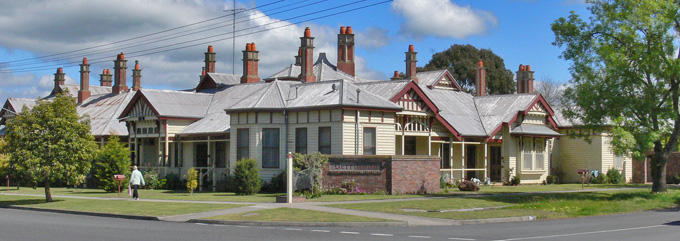
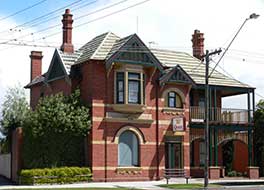
Derrinook
On the corner of Gellibrand and Manifold Streets, Derrinook was built of timber in 1900 as a private hospital in the Early Federation style, with many elaborate, tall chimneys capped with ceramic chimney pots. This was one of the first buildings in Colac to employ electric lighting, and was converted after the second World War into self-contained flats.

Thornbank
Moore Street, west Colac. Built in 1855–56 for Edward Bage, the District Surveyor who probably also designed the building, it is one of the oldest surviving houses in the area, now nestling inconspicuously in a ‘suburban’ streetscape. A single-storeyed building in the ‘Australian Colonial’ style, with English, Georgian and Gothic influences, its extensive verandahs have decorative fretwork and iron posts. Brick stables and groom’s quarters still exist, but the extensive gardens have been considerably reduced. A private residence classified by the National Trust.

Thornbank illustrated in an early engraving.

Timber cottages
27–29 Manifold Street. Built in 1864. Typical of many small dwellings built in the early days of settlement.
No. 1 Murray StreetBuilding erected on the corner of Murray and Queen Streets in 1871 for Adam Rae's Western Stores. More recently it has housed a number of businesses including restaurants, presently a gift shop. This was originally the site of the 'Crook and Plaid' Inn, built in 1844, one of the first buildings in Colac. This view shows the Queen Street facade. |
 |
Old Post OfficeNo. 4 Murray Street. Built in 1876, now operated as a Chinese restaurant, but because it is protected by the National Heritage Committee, no exterior advertising is permitted. The telephone exchange commenced here in 1904 with 25 subscribers. |
 |
 |
26 Murray StreetBuilt in 1885 and formerly a gentleman's club, then the National Bank, the building is now used as offices. |
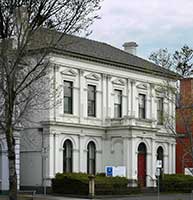
Old Shire of Colac HallAt 6 Murray Street, next door to the old Post Office building (above), this Italianate building was erected in 1879 after the first Hall was declared unsafe only 14 years after being built in 1865. It is now occupied by Colac Adult Education and Aged Care Services. |
 |
 |
Prince of Wales Hotel8 Murray Street, just east of Barongarook Creek. First Licenced in 1875 and operated as a hotel until 1921. Presently the building houses tea rooms and bed and breakfast accommodation. |
Balnagowan
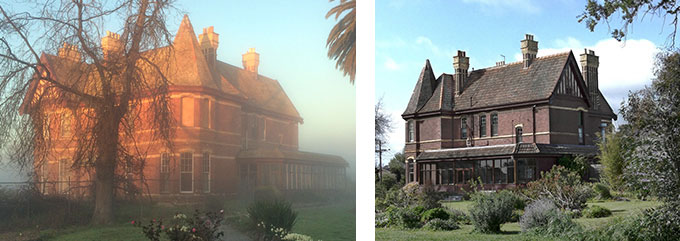
Balnagowan was built on Lake Colac in 1892 for grazier Alexander Fraser
Ross, a grand residence with elements of the Queen Anne/Elizabethan style.
The interior retains much of its original splendour including solid walnut
doors, Kauri pine parquetry floors, a stately entrance foyer with magnificent
walnut staircase and fine leadlight windows.
The property is being developed as a retirement village with the restored Balnagowan as its centrepiece.
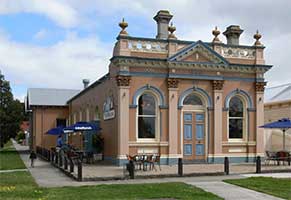 |
Oddfellow's HallCorner of Dennis and Gellibrand Streets. Built in 1870 as the Lodge Hall for the Independent Order of Oddfellows. Later used as a community hall, then occupied by panel beaters before being restored in 1999 as Duff's Restaurant. The restaurant was sold in 2009 and renamed Oddfellow's Restaurant. The new owners gutted the previously restored interior, although the exterior remains intact. |
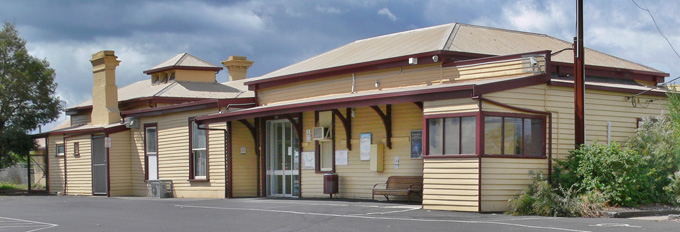
Colac Railway Station
When the railway line west from Geelong reached Colac in 1877, the new station consisted of a collection of temporary wooden buildings built on a brick-faced passenger platform and a brick goods shed. Although a brick station building was proposed, similar to others on the line such as at Birregurra, Colac businesspeople lobbied for a timber structure so that local builders and timber suppliers could bid for the construction. The building which remains today was completed in 1879 and originally included a Station Master's residence, bars, a refreshment room, kitchen, toilets and a ticket office, with a parcels office in a separate building.
Prebyterian ManseThe former Prebyterian Manse, located on the corner of Corangamite and Pollack Streets. It is now a private residence. |
 |
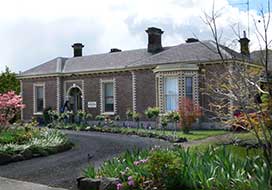
The ElmsBuilt around 1880 for Dr T. Foster, first medical officer at Colac Community Hospital. It is a solid brick house with a slate roof and several red brick chimneys, it once sat in extensive grounds with outbuildings, tennis court, formal and kitchen gardens and a separate smoking and billiard room. |
 |
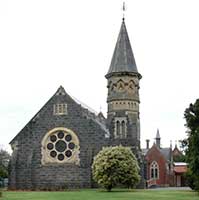 |
St Andrews Uniting ChurchA striking church in built from bluestone brought from New Zealand as ballast for sailing ships on their way to the gold rush. Colac’s third Presbyterian church, it was designed by Peter Matthews and built in 1877. The building is of particular interest for its squat octagonal tower with slate spire, plate-traceried rose window, iron roof ridging and finials. Classified by the National Trust. |
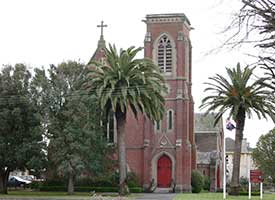
St John's Church of EnglandBuilt in 1891 by Mr Humphrey Hearn. Of interest is a leadlight window honouring pioneers of the Irrewillipe area south of Colac. |
 |
Lislea HouseCorner Bromfield and Corangamite Streets. Originally built in 1892 as a surgery and residence for Dr Wynne, now operating as bed and breakfast accommodation. |
 |
 |
GlenoraCorner Bromfield and Corangamite Streets. An Edwardian building, originally a surgery and residence for Dr Gibbs. Now solicitor’s offices. |
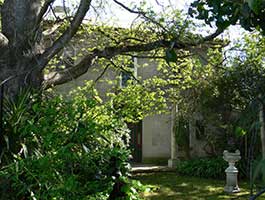
OakbankBuilt in 1883 at a cost of £1000 as a ten-roomed parsonage for Colac Methodist Church, a gift to the church by pastoralist Alexander Dennis. Designed in Georgian Revival style by Colac Architect Alexander Hamilton, square, two-storeyed with minimal decoration. Passing into private hands in 1946, the building is classified by the National Trust. |
 |