Lake Colac
With a surface area of 2,778 hectares, Lake Colac has a circumference of 33 km and is relatively shallow, with an average maximum depth of no more than 2.5 metres. In recent years it has been well below that level. It is a popular location for fishing and water activities.
The lake is part of the landlocked Corangamite basin formed by early (Pleistocene and Tertiary) volcanic activity. Volcanic activity blocked the natural outflow of Lake Colac's two tributaries, Deans Creek and Barongarook Creek, to the south of the lake, causing the rivers to flow into the basin, leaving alluvial deposits. Wind action caused crescent-shaped dunes to form, creating many of these shallow lakes and wetlands.
1870 saw the first pleasure boats on Lake Colac and the first regatta on Lake Colac was held in 1879. By the beginning of the 1900s two jetties were built and the jetty at Landing Place, which was located on the shore below the Botanic Gardens, offered boats for hire. Records indicate that the Rowing Club was officially founded in 1872. The club continues to flourish today as rowing is still feasible in the shallow water, and has a proud record of successes, with Kevin Wickham becoming Colac's first Olympian in 1964.
The Rowing Club building was rebuilt and reopened in 1957, and now houses the Colac City Band on its upper floor.
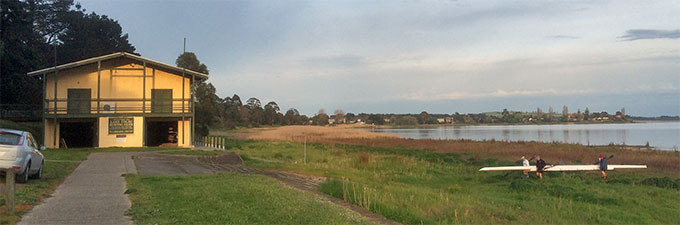
The Colac Rowing Club in September 2014. Low water level in the lake means club members have to carry their boats out to the water.
The Dorothy was a pleasure steamer which carried passengers on pleasure cruises from Landing Place between 1912 and 1914. It was launched from the area in front of what is now the Yacht Club.
People swam in the lake in warmer weather, a rare occurrence these days, and early Church of Christ records show that baptisms were performed in the lake. In 1872 Mr G. Mitchelmore erected bathing houses on the lakeshore. A single bath cost fourpence and a season ticket one guinea, but the venture proved to be failure.
An early photograph showing original pier and boathouse, known as Landing Place, below the Botanical Gardens at the eastern end of the lake foreshore. |
 |
The rowing club, at Landing Place, and the yacht club, at the other end of the foreshore, near Ross Point, are on the shores of the lake with sailing taking place each weekend during summer and a sailing regatta in January. Unfortunately drought conditions have curtailed these activities in recent years.

The Colac Yacht Club Jetty standing high and dry in mud early in the recent drought.
Present status of Lake Colac
While 2010 saw the ending of a major drought with reasonable rains, and average rainfall since, the water level in Lake Colac remains below the minimum levels acceptable for most boating purposes, other than rowing boats, 'tinnies' and kayaks. No boat ramps are presently usable (September 2014), and access to the water is made difficult by a muddy, grassy foreshore.
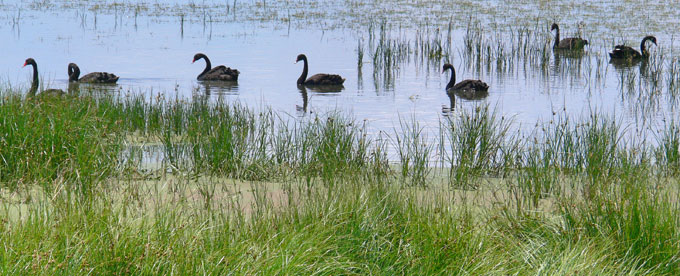
Black swans found the lake foreshore a perfect place to nest around 2010-2011.
The lake drained
In the summer of 2008-2009 Lake Colac dried out completely, believed by many to be the driest the lake has been since white settlement.

By the following summer, 2009-2010, the lake partially refilled but in 2014 there is still insufficient water for most boating or fishing activities.
The view below taken during the drought is from one of the jetties adjacent to the Colac Camping Ground at the eastern end of the Colac foreshore. The three hills on the horizon are known as the Warrions.

Facilities at Lake Colac
Parking areas, electric barbecues, picnic tables and public toilets can be found at the eastern end of the lake foreshore, below the Botanic Gardens.
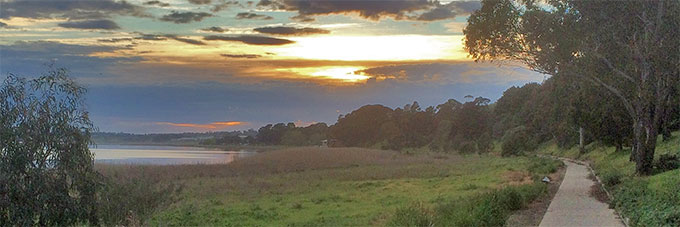
A walking and cycling path runs the full length of the lake foreshore, from Stodart Street and Balnagowan at the western end, to the area below the Botanic Gardens.
Meredith Park
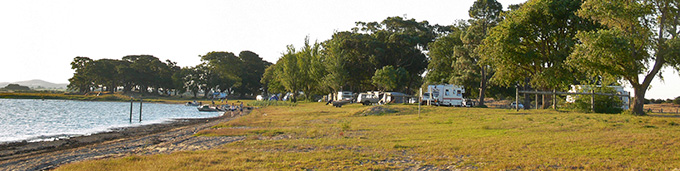
This popular campsite and fishing beach is reached by turning off to the left, 10km north of Colac on road to Beeac. There are toilets, fireplaces and a boat ramp.
Bird Sanctuary
Lake Colac and the Bird Sanctuary provide important feeding, resting and breeding habitat for over 20 species of waterbirds, including a number of migratory species that are listed under agreements between the Australia and Japan and China for the protection of migratory birds and their habitats that are in danger of extinction.
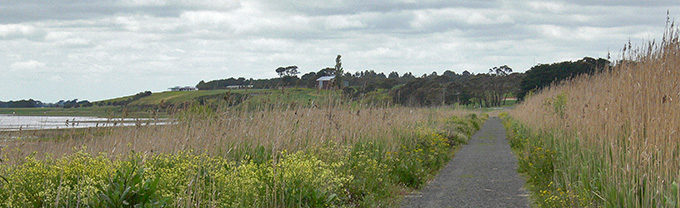
Wetlands protect and improve water quality, play a major role in nutrient recycling
and provide habitat for a diverse range of plants and animals. Some wetland
inhabitants are waterbirds such as the purple swamp hen, the native water rat,
frogs, snakes, invertebrates and fish species as well as waterplants such as
sedges, rushes and water-loving trees.
The Sanctuary is located on the Esplanade at the lakeside end of Church Street.
Tachyglossus mosaic
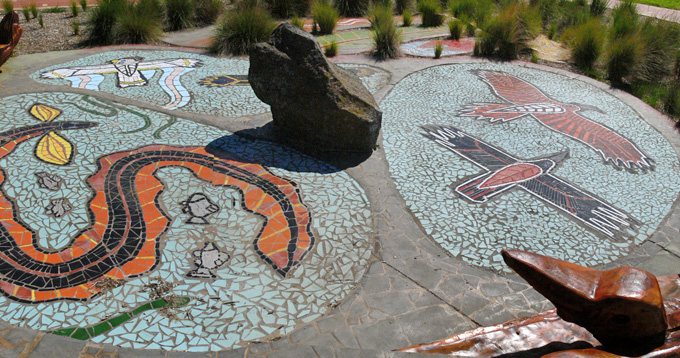
A pathway of bricks along the lake foreshore, sponsored
by local residents and businesses, leads past the Tachyglossus mosaic, the
work of local artists, schools, community organisations and community members. Tachyglossus was
an ancient ancestor of the echidna which roamed the western basalt plains
approximately 40,000 years ago.
The mosaic is in the shape of Lake Colac, divided into sections representing
totems used by the local indigenous people.
- Bunjil the wedge tailed eagle and Waa the Crow, flying in the direction of
Wathaurong country to the East.
- Black and white cockatoos flying in the direction of the Mara nations to
the west.
- The eel and smelt, a small fish, important food sources for the Coladjin
people. Water ribbons found in some of the local streams surround the eel and
fish.
The claws of the tachyglossus footprint depict from left to right:
- The boomerang
- The Manna gum leaf, once common, now rare.
- Red Rock as a volcano exploding 12,000years ago
- A site line and contour map of Red Rock.
The front of the mosaic is shaped to symbolise the Red Rock skyline to the
north and the stone wall follows the shape of the Otway's skyline to the south.
The cypress pine seating is carved with images that reinforce the theme of
local indigenous flora and fauna.
The installation is surrounded by plants once abundant in the area. Mosaic
Artist: Libby McKinnon - Designer: Glenn Romanis - Wood Carvers: John McCall
and Brad West - Stone Wall Artisan: Simon Witham - Indigenous plantings: Rob
Graner.
Fish in Lake Colac
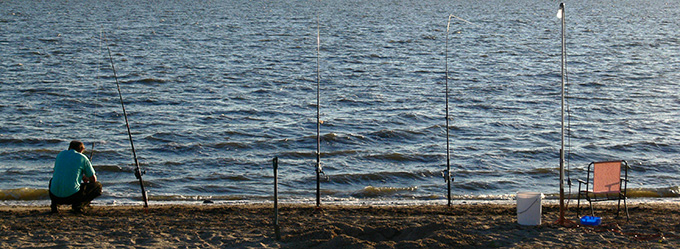
The first unsuccessful attempt to stock Lake Colac with fish was made in 1858.
Lake Colac contains abundant redfin to 2kg, (average 400g), short-finned eel, carp, tench, goldfish, common galaxias, flat-headed gudgeon and Australian smelt. It is a very popular lake for redfin fishing and is fished commercially for eels. A good fishing method for redfin is to fish on the bottom with Australian smelt or common galaxias, which can also be found in the lake, as bait.
Ross Point near Balnagowan House is a popular fishing spot at the west end of the lake foreshore. There is a car park off Balnagowan Avenue, and another, along with a playground and reserve, at the end of Stodart Street.
